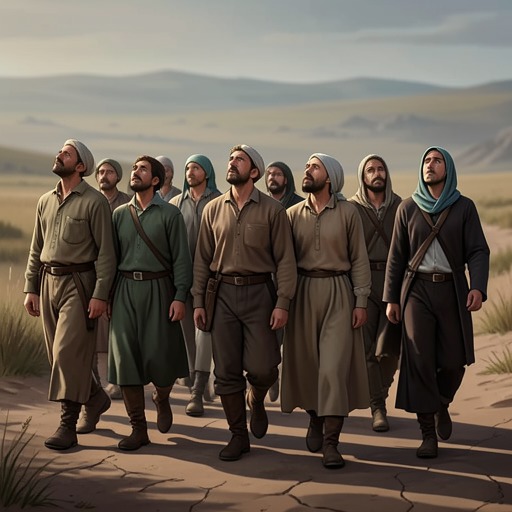
Sarpanch Muhammad Din
The Satanic VersesSarpanch Muhammad Din is the headman of Titlipur, a village whose everyday concerns include crops, potato quotas, and the obligations of communal life. When Ayesha returns from her disappearance claiming that Gibreel Farishta has brought a command for the village, Muhammad Din has to decide whether his responsibilities lie in preserving ordinary life or carrying out a demand that overturns it. His arc is not that of a visionary: he begins as a cautious local authority, becomes the organizer of a collective pilgrimage, and survives the catastrophe at its destination. Through him, the novel shows how an extraordinary religious claim becomes a practical decision shared by a village, with consequences that no one can manage once the group reaches the sea.
Headman and Household
At first, Muhammad Din’s attention is firmly on the mundane. When Ayesha reports that Gibreel Farishta appeared to her in a vision, she finds a headman more preoccupied with potato quotas than with transcendence. Her announcement that greatness has come to the village introduces a new kind of authority into a life organized around local administration. Muhammad Din does not immediately become her unquestioning follower; he is the person she must approach, and his response helps determine whether her claim will remain a private vision or become a matter for the community.
His household gives this authority a human and domestic setting. Khadija, his wife, comforts Osman when Ayesha’s return leaves him grieving, though her attempt at consolation is awkward. Later, as the pilgrimage is being planned, Khadija objects to Muhammad Din’s proposal to have a carpenter build litters for older and infirm villagers. The command, as the village understands it, is to walk; she insists that the arrangement cannot exempt people from that requirement. Her intervention redirects her husband’s practical planning, while their shared decision to join the march places their marriage within the same test of faith and endurance as the rest of the village.
A Command Becomes a Collective Decision
On the seventh day after her disappearance, Ayesha returns to Muhammad Din’s home and asks him to convene the Titlipur panchayat that evening. Before the council, she says that Gibreel Farishta has carried her to the lote-tree of the uttermost end and delivered a message that is also a command: the men, women, and children of the village must prepare to walk to Mecca, to the Kaaba at the center of the Haram Sharif. Muhammad Din’s part is initially to make room for deliberation. He asks what the angel requires, then raises the hardship of leaving the village and points out that religious observance allows exceptions for people unable to make the journey because of poverty or illness.
The council’s debate brings the practical stakes into focus. The villagers have crops and homes to consider, and the route presents an apparently insurmountable obstacle: nearly two hundred miles to the sea, followed by the ocean between them and Mecca. Osman voices these difficulties, including the presence of older people and babies. Muhammad Din rebukes him and tells him to learn the ways of the faith and village. The rebuke marks a shift: instead of treating Osman’s objections as grounds to reopen the decision, the headman defends the community’s emerging discipline. Ayesha then answers that the waters will part when the pilgrims reach the shore. The council’s decision is described as arriving in a long, wordless silence; Muhammad Din’s questions and objections give way to a resolution the narrative says was unanimous.
Organizing the March
The next morning, the village is already preparing to leave. Muhammad Din first considers how ox-drawn litters might carry older or infirm pilgrims, but Khadija’s objection leads him to abandon that accommodation. Only the youngest infants will be excused from walking, and adults will carry them in rotation. The villagers pool their food and supplies: potatoes, lentils, rice, vegetables, cooking utensils, and bedding gather beside the panchayat branch. Beasts of burden and a couple of carts will carry some provisions, while the Sarpanch instructs the pilgrims to limit their personal belongings. These details make his leadership concrete: the divine command is translated into decisions about weight, food, transport, and who must walk.
The zamindar Mirza Saeed Akhtar tries to halt the departure. He arrives in anger, makes speeches, and shakes individual villagers by the shoulders, but delays the preparations for only forty-five minutes before leaving. Muhammad Din’s authority proves more durable than the zamindar’s attempt to restore the previous order. By sunset, the group is ready. He schedules prayers in the small hours so they can set out before the worst of the day’s heat. That night, he tells Khadija that he has long hoped to see the Kaaba and circle it before he dies; she shares the hope and the expectation that they will walk through the waters together. Their private exchange gives the march a personal meaning, but does not alter the risks the village has accepted.
The Pilgrimage and Its Cost
The journey proceeds at the pace of its slowest members: three hours of walking in the morning and three more after the heat, interrupted by children’s illnesses, harassment from authorities, and practical setbacks such as a cart wheel coming off. At best the pilgrims cover two miles a day, with roughly 150 miles still to go and an estimated eleven weeks before they reach the sea. On the eighteenth day, Khadija dreams that she sees Azraeel, the angel of death, but says nothing to her husband about the vision. The following morning she asks to rest at a ruined wayside inn and tells Muhammad Din that he can catch up with the others later. The scene foreshadows the losses of the journey without showing Muhammad Din abandoning the pilgrimage.
By the ninth week, the march has attracted journalists, politicians, commercial sponsors, tourists, and religious extremists. The pilgrims’ public visibility turns their journey into a contested spectacle: some observers seek a story or a commercial opportunity, while extremists accuse the Ayesha Haj of appropriating a national tradition and inflaming communal tensions. Muhammad Din’s earlier decision has therefore carried the village out of its local sphere and into a national argument, though the evidence does not make him its public spokesman. The group continues to the coast, where its passage from the city to the Arabian Sea fulfills the geographic destination of the march, not its promised safe crossing.
At the Arabian Sea
At the shore, Muhammad Din sees Khadija being supported by two villagers because she is too weak to stand by herself. Ayesha is beside her. When the pilgrims enter the sea, they do not return: Ayesha, Mishal Akhtar, and the villagers of Titlipur sink below sea level and are never seen again. Muhammad Din runs into the water with the other survivors, calling for help, but is dragged back out. Unlike Khadija and the rest of the village, he survives; unlike Mirza Saeed Akhtar, he does not continue diving farther out after them. Once he has been pulled from the sea, the pilgrimage is over.
His ending leaves the village’s journey without the anticipated return or deliverance. Muhammad Din had begun by weighing a command against crops, homes, and the limits of religious obligation; he then helped turn belief into a disciplined collective undertaking, even as the march exposed dissent, hardship, and death. At the water’s edge, neither his office nor the community’s preparations can control what happens. His survival is a narrow remainder of the pilgrimage, not a resolution of its promise: he returns from the sea while the people he led do not.